Impact of ambient temperature on the cooling of power transformers: a CFD investigation for regions of the state of Espírito Santo
DOI:
https://doi.org/10.47456/bjpe.v12i2.51402Keywords:
Electrical transformers, ambient temperature, CFD, sustainabilityAbstract
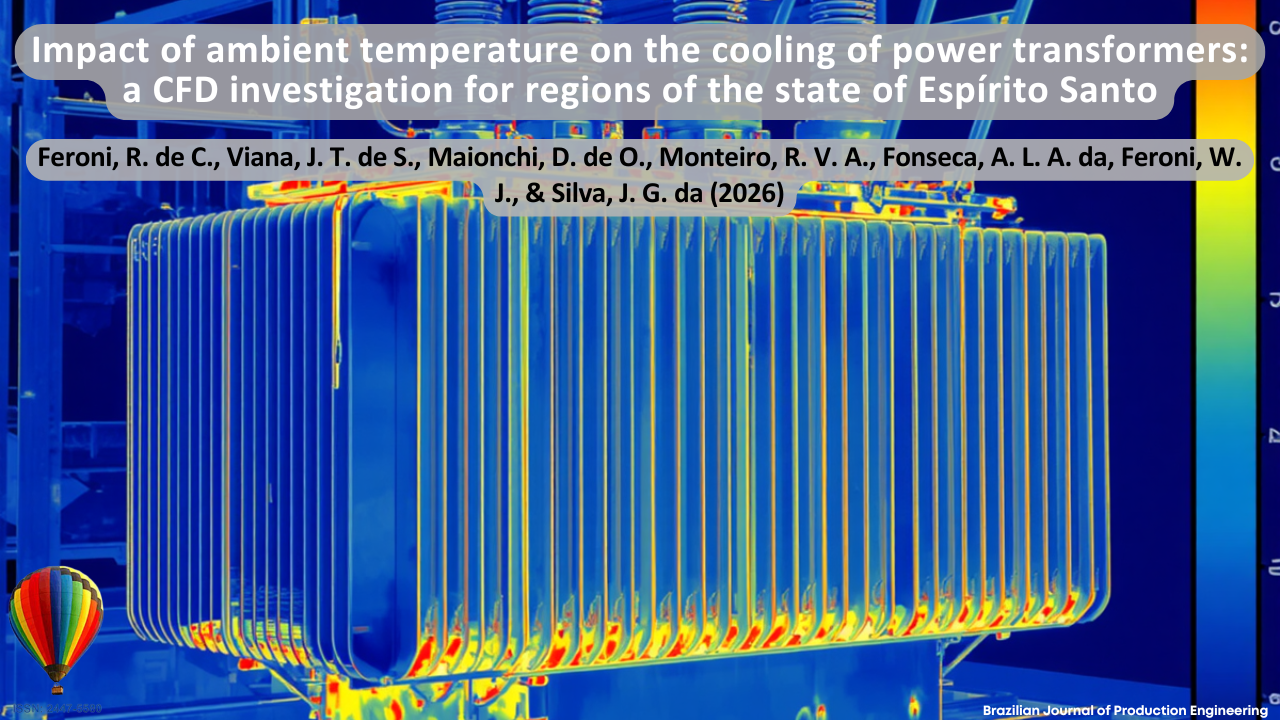
Electrical transformers are being studied to increase energy efficiency and reduce environmental impact. In this context, the objective of the present work is to evaluate, using computational fluid dynamics (CFD), the impact of ambient temperature on the cooling of electrical transformers for different temperature values, covering the climatic conditions of regions in the state of Espírito Santo, Brazil. A 250 kVA electrical transformer was studied using CFD, with the air temperatures of the municipalities of interest applied as boundary conditions in the modeling. The results show that february is historically the hottest month, with the highest average maximum temperature in Alegre at 34.2 °C, and peak temperatures were recorded in Marilândia (42.1 °C) and Ecoporanga (40.0 °C). From the computational simulation, it was observed that temperature is distributed from its maximum values near the surfaces of the coils and the core to its minimum values at the external surfaces of the transformer. The average and maximum oil temperatures increase as the ambient temperature rises, due to the decrease in heat dissipation to the outside. This result suggests that greater attention should be given to devices installed in the municipalities of Alegre, Marilândia, and Ecoporanga.
Downloads
References
ABNT. (2025). ABNT NBR 5356-1:2025. Recuperado de https://www.abntcatalogo.com.br/grd.aspx
Abduladheem, A. A. & Hasan, M. I. (2019). Using of PCM as an energy storage material to improve the cooling process in electrical transformers. University of Thi-Qar Journal for Engineering Sciences, 10(2), 98-104.
Ajayi, A. O., Maryjane, O. C., Emmanuel, A., & Nwanevu, C. (2025). Sustainability in transformer manufacturing: The role of renewable energy in automating coil winding machines. World Journal of Advanced Research and Reviews, 25(1), 957-976.
Ali, S. A., Hasan, I. A., & Hussain, E. (2022). A comparison between half and full fins at nanofluids in transformers. IOP Conference Series: Earth and Environmental Science, 012088.
Altoé, L., Feroni, R. C., Júnior, A. A. M. P., Lima, P. R., Galvão, E. S., & Feroni, W. J. (2025). Análise do cenário energético brasileiro no período 2014-2023. Revista Foco, 18(4), e8191.
Amalanathan, A. J., Sarathi, R., & Zdanowski, M. (2023). A critical overview of the impact of nanoparticles in ester fluid for power transformers. Energies, 16(9), 3662.
Amer, A., Shaban, K., Gaouda, A., & Massoud, A. (2021). Home energy management system embedded with a multi-objective demand response optimization model to benefit customers and operators. Energies, 14(2), 257.
Amoiralis, E. I., Tsili, M. A., & Kladas, A. G. (2009). Transformer design and optimization: A literature survey. IEEE Transactions on Power Delivery, 24(4), 1999-2024.
Ariannik, M., Razi-Kazemi, A. A., & Lehtonen, M. (2020). An approach on lifetime estimation of distribution transformers based on degree of polymerization. Reliability Engineering & System Safety, 198, 106881.
Asano, R. & Page, S. A. (2013). Reducing environmental impact and improving safety and performance of power transformers with natural ester dielectric insulating fluids. IEEE Transactions on Industry Applications, 50(1), 134-141.
Azbar, N. M. & Jaffal, H. M. (2020). Experimental study of the thermal performance behavior of electric power transformers. Journal of Engineering and Sustainable Development.
Azbar, N. M., Jaffal, H. M., & Freegah, B. (2021). Enhancement of the thermal performance characteristics of an electrical power transformer. Engineering Science & Technology, 1-21.
Brasil. (2021). Plano Decenal de Expansão de Energia 2030. MME/EPE. Recuperado de https://www.epe.gov.br/pt/publicacoes-dados-abertos/publicacoes/plano-decenal-de-expansao-de-energia-2030.
Brasil. (2025). Ministério de Minas e Energia. Recuperado de https://www.gov.br/mme/pt-br/assuntos/noticias/silveira-anuncia-r-5-bilhoes-em-investimentos-no-espirito-santo-ate-2030.
Cavus, M. (2025). Advancing power systems with renewable energy and intelligent technologies: A comprehensive review on grid transformation and integration. Electronics, 14(6), 1159.
Daghrah, M., Wang, Z., Liu, Q., Hilker, A., & Gyore, A. (2019). Experimental study of the influence of different liquids on the transformer cooling performance. IEEE Transactions on Power Delivery, 34(2), 588–595.
Dastjerd, F. T., Eidgah, E. E. F., Niazmand, H., & Arabkoohsar, A. (2025). Thermal and electromagnetic analysis of a 200 kVA transformer with heat pipe cooling. Energy Conversion and Management: X, 101103.
Del Vecchio, R., Del Vecchio, R. M., Poulin, B., Feghali, P., Shah, D., & Ahuja, R. (2017). Transformer design principles. CRC press.
EDP. (2024). EDP Brasil. Recuperado de https://www.edp.com.br/noticias/artigo/edp-anuncia-investimento-de-r-5-bilhoes-ate-2030-no-espirito-santo.
EPE. (2025). Balanço Energético Nacional 2025. Recuperado de https://www.epe.gov.br/pt/publicacoes-dados-abertos/publicacoes/balanco-energetico-nacional-2025.
Fernández, I., Ortiz, A., Delgado, F., Renedo, C., & Pérez, S. (2013). Comparative evaluation of alternative fluids for power transformers. Electric Power Systems Research, 98, 58-69.
Feroni, R. C., & Galvão, E. S. (2020). Sustainable development indicators assessment for the city of Anchieta-ES Brazil at different times of the local economy. International Journal of Sustainable Development & World Ecology, 27(6), 524-533.
Gatto, A. (2022). The energy futures we want: A research and policy agenda for energy transitions. Energy Research & Social Science, 89, 102639.
Gmati, G., Rao, U. M., Fofana, I., Picher, P., Arroyo-Feràndez, O., & Rebaine, D. (2023). Bubbling phenomena in liquid-filled transformers: Background and assessment. Energies, 16(9), 3829.
Godina, R., Rodrigues, E. M. G., Matias, J. C. O., & Catalão, J. P. S. (2015). Effect of loads and other key factors on oil-transformer ageing: Sustainability benefits and challenges. Energies, 8(10), 12147-12186.
Golam, A. S. (2024). Evaluation of the electrical power transformer fins design technology: Numerical analysis and experimental validation. Journal of Advanced Research in Fluid Mechanics and Thermal Sciences, 117(2), 131-146.
Hachem, D. W., Faria, L., & Aponte, W. I. G. (2022). A energia elétrica como condição material para o gozo dos direitos humanos: Um direito fundamental implícito. Veredas do Direito, 19(43), 173-196.
Hannun, R. M., Hammadi, S. H., & Khalaf, M. H. (2018). Effect of location and direct solar radiation on the performance of electric power transformer.
Hannun, R. M., Hammadi, S. H., & Khalaf, M. H. (2019). Heat transfer enhancement from power transformer immersed in oil by earth air heat exchanger. Thermal Science, 23(6A), 3591-3602.
Hasan, M. I. (2017a). Improving the cooling performance of electrical distribution transformer using transformer oil–based MEPCM suspension. Engineering Science and Technology, an International Journal, 20(2), 502-510.
Hasan, M. I. (2017b). Using the transformer oil-based nanofluid for cooling of power distribution transformer. International Journal of Energy and Environment, 8(3), 229-238.
Hashim, M. M., & Basher, H. (2024). A numerical study of the effect of different geometrical parameters on the cooling processes in electrical transformer. Wasit Journal of Engineering Sciences, 12(4), 78-94.
Hernandez-Robles, I. A., Gonzalez-Ramirez, X., Olivares-Galvan, J. C., Escarela-Perez, R., & Ocon-Valdez, R. (2024). Analysing and computing the impact of geometric asymmetric coils on transformer stray losses. Applied System Innovation, 7(2), 26.
IBGE. (2025). Cidades e Estados - Espírito Santo. https://www.ibge.gov.br/cidades-e-estados/es.html.
IEC. (2011). IEC 60076-1:2011. Recuperado de https://webstore.iec.ch/en/publication/588.
IEEE. (2021). IEEE C57.12.00-2021. Recuperado de https://standards-ieee-org.translate.goog/ieee/C57.12.00/6962.
INCAPER. (2025). Meteorologia INCAPER. Recuperado de https://meteorologia.incaper.es.gov.br/legenda_regioes.
INMET. (2025). Banco de Dados Meteorológicos para Ensino e Pesquisa. Recuperado de https://bdmep.inmet.gov.br
Janic, Z., Gavrilov, N., & Roketinec, I. (2023). Influence of cooling management to transformer efficiency and ageing. Energies, 16(12), 4626.
Leal, C. (2025). Pódio Capixaba: três cidades do ES registram temperaturas mais altas do Brasil. Recuperado de https://www.agazeta.com.br/agora/podio-capixaba-tres-cidades-do-es-registram-temperaturas-mais-altas-do-brasil-0225.
Murugan, R., & Ramasamy, R. (2015). Failure analysis of power transformer for effective maintenance planning in electric utilities. Engineering Failure Analysis, 55, 182-192.
Nogueira, G. C., Medeiros, L. H., Oliveira, M. M., Barth, N. D., Bender, V. C., Marchesan, T. B., & Falcão, C. E. G. (2021). Thermal analysis of power transformers with different cooling systems using computational fluid dynamics. Journal of Control, Automation and Electrical Systems, 33(1), 359-368.
Pop, I., & Ingham, D. B. (2001). Convective heat transfer: Mathematical and computational modelling of viscous fluids and porous media. Elsevier.
Raeisian, L., Niazmand, H., Ebrahimnia-Bajestan, E., & Werle, P. (2019). Thermal management of a distribution transformer: An optimization study of the cooling system using CFD and response surface methodology. International Journal of Electrical Power & Energy Systems, 104, 443-455.
Rexhepi, V., & Hulaj, A. (2020). Monitoring parameters of power transformers in the electrical power system through smart devices. Journal of Energy Systems, 4(2), 48-57.
Schneider Electric, A. E. (2002). Use and maintenance of ELVIM oil-immersed distribution transformers.
Shiri, A., Gholami, A., & Shoulaie, A. (2011). Investigation of the ambient temperature effects on transformer’s insulation life. Electrical Engineering, 93(3), 193–197.
Silva Jr., O., Coninck, J. C. P., Magrin, F. G. S., Ganacim, F. I. S., Pombeiro, A., Fernandes, L. G., & Romaneli, E. F. R. (2023). Impacts of atmospheric and load conditions on the power substation equipment temperature model. Energies, 16(11), 4295.
Sorte, S., Salgado, A., Monteiro, A. F., Ventura, D., Martins, N., & Oliveira, M. S. A. (2025). Advancing power transformer cooling: The role of fluids and nanofluids—a comprehensive review. Materials, 18(5), 923.
United Nations General Assembly. (2015). Transforming our world: The 2030 agenda for sustainable development (A/RES/70/1). United Nations Organization.
Ynoue, R. Y., Reboita, M. S., Ambrizzi, T., & Silva, G. A. (2017). Meteorologia: Noções básicas. Oficina de Textos.
Ziomek, W. (2013). Transformer electrical insulation. IEEE Transactions on Dielectrics and Electrical Insulation, 19(6), 1841-1842.
Published
Issue
Section
License
Copyright (c) 2026 Feroni, R. de C., Viana, J. T. de S., Maionchi, D. de O., Monteiro, R. V. A., Fonseca, A. L. A. da, Feroni, W. J., & Silva, J. G. da.

This work is licensed under a Creative Commons Attribution 4.0 International License.

All works published in the Brazilian Journal of Production Engineering (BJPE) are licensed under Creative Commons Attribution 4.0 International (CC BY 4.0).
This means that:
Anyone can copy, distribute, display, adapt, remix, and even commercially use the content published in the journal;
Provided that due credit is given to the authors and to BJPE as the original source;
No additional permission is required for reuse, as long as the license terms are respected.
This policy complies with the principles of open access, promoting the broad dissemination of scientific knowledge.


2.png)